


If we consider today’s constructions, whether they’re offices, homes, or even medical facilities, one thing’s for sure: people want openness, but they also want privacy. People want natural light, but they don’t want it to be too harsh. People want stylish glass partitions, but they also want to feel like they’re not being exposed to the world.
That’s exactly where smart glass comes in. The first time you see it change from clear to frost in seconds, it feels almost like magic. But of course, it’s not magic, it’s science. In this blog, we will explore what actually happens inside smart glass, what PDLC (Polymer Dispersed Liquid Crystal) technology truly means, how it controls light, and why more people are opting for PDLC switchable glass in Kochi, Kerala, India, for their homes and commercial spaces. We’ll also discuss how to select a reliable Smart Glass Manufacturer and address some common questions people often have.
So let’s get into it.
What is Smart Glass, Really?
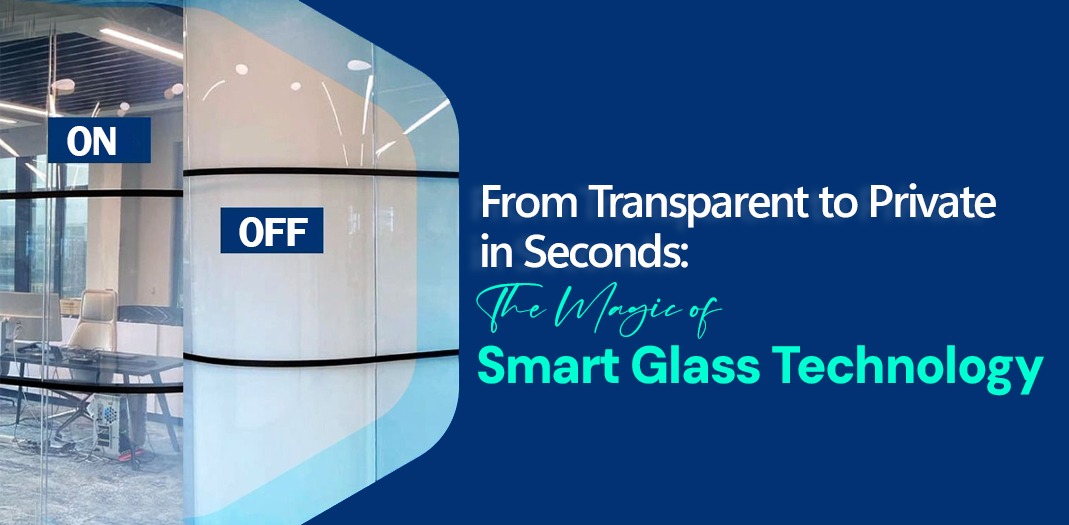
Smart glass is glass that can change from transparent to opaque when electricity is applied. That’s it. No curtains, no blinds, no sliding panels. Just a switch… and privacy.
When it’s ON — the glass is clear.
When it’s OFF — the glass becomes frosted.
Very simple to use. Very clean look. And, once people install it, they rarely want to go back to curtains again.
The Real Science behind PDLC Technology
Most smart glass today works using something called PDLC technology. The name sounds technical, But the idea is actually quite easy to understand.
What makes the glass “smart” is a special PDLC film that contains millions of tiny liquid crystal droplets spread inside a polymer layer. In practical applications like ours, this film is applied onto the dry surface of the glass and connected to a conductive layer, allowing it to react to electricity.
So the glass itself remains normal glass — the smart functionality comes from the PDLC film applied on top of it.
And this material reacts to electricity.
How PDLC Smart Glass Actually Works
This is the part many people find fascinating.
The whole working principle depends on how these tiny liquid crystal molecules behave when electricity is applied.
When Power is OFF — Privacy Mode
When no electricity flows:
- The liquid crystal molecules are scattered randomly.
- Light entering the glass gets scattered in different directions.
- Because light cannot pass straight through, the glass looks frosted.
So you get privacy. But still soft, diffused light comes inside.
When Power is ON — Transparent Mode
When electricity is applied:
- The liquid crystal molecules align in one direction.
- Light passes straight through.
- The glass becomes clear.
And this happens very fast… almost instantly. One moment it’s frosted, the next moment completely transparent.
The Science in Simple Words
If we simplify the science:
Random molecules → light scatters → glass looks opaque
Aligned molecules → light passes → glass looks clear
That’s the whole concept. Electricity controls molecular alignment, and molecular alignment controls light.
Why People Are Choosing Smart Glass
There are many practical reasons why smart glass is becoming popular, especially in modern construction.
Instant Privacy
No waiting, no adjustments. Just press a switch.
Energy Efficiency
It helps control heat and glare. So the cooling load can be reduced slightly.
UV Protection
Blocks harmful UV rays. Helps protect furniture and interiors.
No Maintenance Headache
No fabric, no dust, no cleaning blinds again and again.
Clean Modern Look
It just looks premium. Minimal and elegant.
Because of these benefits, demand for PDLC switchable glass, is growing very fast, especially in offices and luxury homes.
Where Can Smart Glass Be Used?
Almost anywhere you use regular glass.
Homes — bathrooms, bedrooms, balconies
Offices — conference rooms, partitions, cabins
Hospitals — patient privacy panels
Hotels — luxury rooms and bathrooms
Retail — display glass and projection screens
Why Quality Matters
Not all smart glass performs the same. The clarity, switching speed, and durability all depend on manufacturing quality.
So choosing an experienced Smart Glass Manufacturer in Kochi, Kerala, India is very important. Proper installation, correct electrical setup, and good materials all make a big difference in long-term performance.
It’s not something you want to compromise on.
Frequently Asked Questions (FAQ)
- What is PDLC switchable glass?
It is smart glass that changes from clear to frosted using polymer-dispersed liquid crystal technology when electricity is applied. - Does smart glass consume a lot of power?
No, power consumption is quite low. It mainly uses electricity when in transparent mode. - How fast does the glass switch?
Very fast — usually within milliseconds. Practically instant. - Does it block UV rays?
Yes, most PDLC smart glass blocks a large percentage of UV radiation. - Is it safe and durable?
Yes. It is laminated safety glass designed for strength and long-term use.
Final Thoughts
As buildings become smarter and spaces become more flexible, solutions like PDLC switchable glass, are no longer a luxury… they are slowly becoming standard design choices.
And with the right Smart Glass Manufacturer you’re not just installing glass , you’re upgrading how your space behaves.
Clear when you want openness. Frosted when you want privacy.